
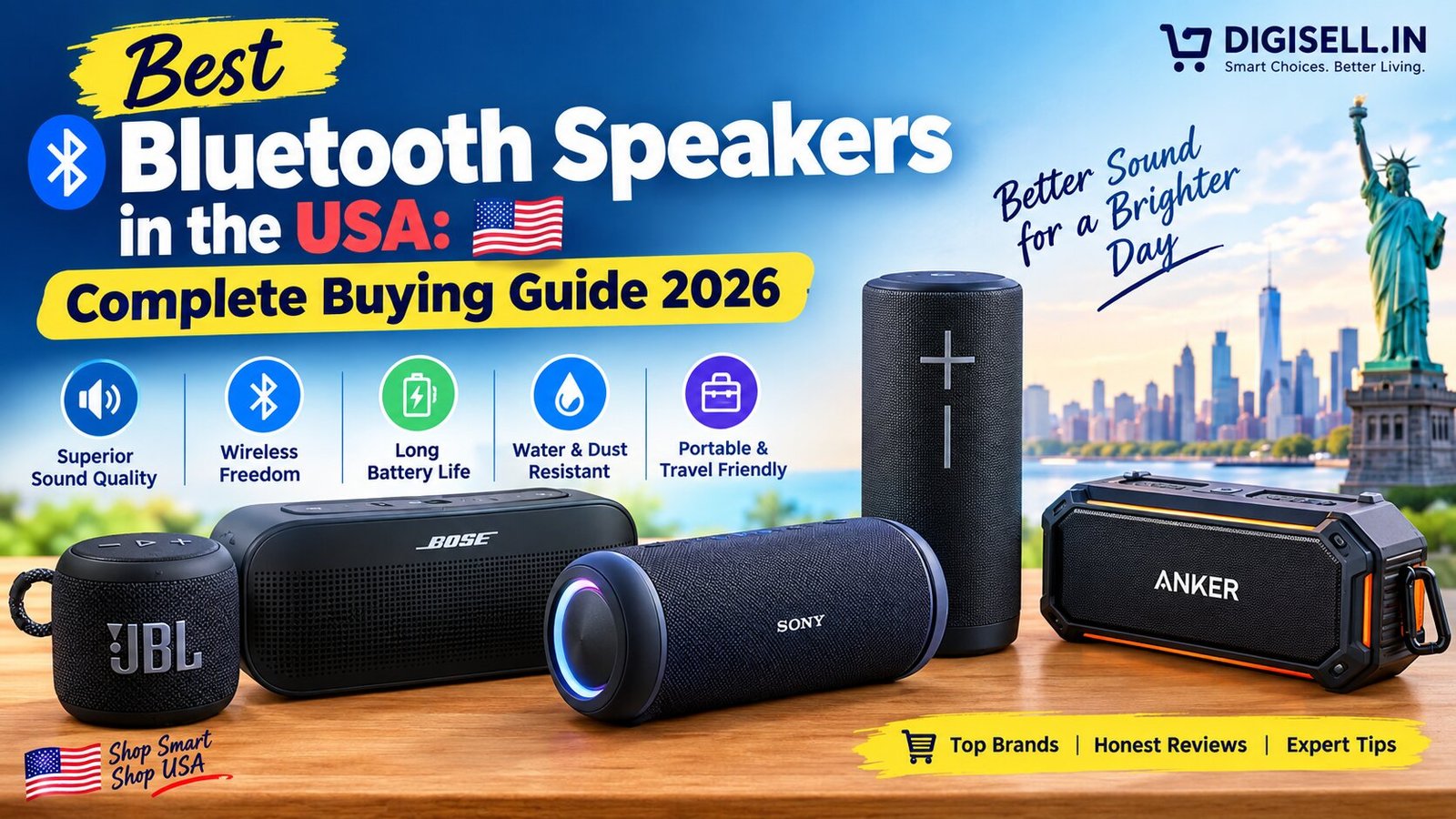
Best Bluetooth Speakers in the USA: Complete Buying Guide
I used to think choosing a Bluetooth speaker was simple: find one with good reviews, check the battery life, and buy it.
I was wrong.
Once I started comparing Bluetooth speakers for different situations—home listening, outdoor gatherings, travel, parties, and everyday use—I realized that the “best” speaker depends heavily on how, where, and why you plan to use it.
A speaker that sounds fantastic in a bedroom may not be the right choice for a backyard party. A compact travel speaker may be convenient but won’t necessarily deliver the bass you’d want for a larger room. And a powerful party speaker can be overkill if all you want is background music while cooking.
So, instead of looking at Bluetooth speakers only by brand or price, I prefer to evaluate them based on real-world use.
This guide explains exactly what I look for when choosing a Bluetooth speaker in the USA.
What Makes a Bluetooth Speaker Worth Buying?
For me, a good Bluetooth speaker needs to get several things right:
- Clear and enjoyable sound
- Enough volume for the intended space
- Reliable Bluetooth connectivity
- Good battery life
- Convenient portability
- Appropriate water and dust resistance
- Strong build quality
- Useful controls
- A price that makes sense for its intended use
The important point is that more expensive doesn’t automatically mean better for everyone.
If you’re buying a speaker for a small apartment, spending hundreds of dollars on an enormous party speaker may not make sense.
Likewise, if you’re planning outdoor gatherings, a tiny pocket speaker may leave you wishing you had bought something more powerful.
My First Step: Decide Where You’ll Use It
Before looking at specifications, I recommend answering one question:
Where will I actually use this speaker?
That question immediately narrows down the options.
1. Bedroom or Small Room
For a bedroom, office, kitchen, or small apartment, I would prioritize:
- Balanced sound
- Compact design
- Low-volume clarity
- Simple controls
- Long battery life
- Easy portability
You don’t necessarily need huge bass or extreme volume.
A compact speaker that sounds good at 20–50% volume can be much more useful than a powerful speaker that feels excessive in a small room.
2. Backyard and Outdoor Use
Outdoor listening changes the requirements.
There are fewer surfaces for sound to reflect from, and environmental noise can compete with your music.
For outdoor use, I look for:
- Higher maximum volume
- Good vocal clarity
- Strong battery life
- Water resistance
- Dust resistance
- Rugged construction
- Convenient carrying options
This is where portable speakers designed for outdoor use become particularly attractive.
3. Beach or Pool
If I were taking a speaker near water, water resistance would move near the top of my checklist.
Look for the speaker’s IP rating rather than simply relying on marketing language such as “waterproof.”
An IP rating provides standardized information about protection against solids and liquids.
For example, an IP67-rated product is designed to provide a high level of dust protection and protection against temporary immersion under specified testing conditions.
However, I would still avoid treating an IP rating as an invitation to deliberately expose electronics to unnecessary water.
How Much Should You Spend on a Bluetooth Speaker?
One of the biggest mistakes is choosing a budget before deciding what you actually need.
I prefer to think about Bluetooth speakers in broad price categories.
| Price Range | Typical Use |
| Under $50 | Basic everyday listening |
| $50–$100 | Portable everyday speakers |
| $100–$200 | Better sound and features |
| $200–$400 | Premium portable/home use |
| $400+ | High-output or specialized speakers |
These are general categories rather than strict rules.
A $70 speaker can be perfect for one person while a $300 speaker may be completely unnecessary.
The goal is to pay for useful performance, not simply a higher price tag.
The Most Important Specification: Sound Quality
When I compare speakers, I don’t look at bass alone.
A speaker can have powerful bass and still sound unpleasant.
Instead, I consider several aspects.
Bass
Bass is important for music genres such as:
- Hip-hop
- EDM
- Pop
- Rock
- Electronic music
But excessive bass can make vocals and instruments less clear.
For everyday listening, I generally prefer a speaker that produces balanced bass rather than simply maximum bass.
Midrange
The midrange is particularly important for:
- Vocals
- Podcasts
- Audiobooks
- YouTube videos
- Interviews
If you regularly listen to spoken content, don’t choose a speaker solely because it has impressive bass.
Clear voices can make a bigger difference to your daily listening experience.
Treble
Treble contributes to detail and clarity.
Too little treble can make music sound dull.
Too much can make certain recordings sound harsh.
That’s why I prefer speakers that maintain a reasonably balanced presentation across different types of content.
Battery Life: Don’t Just Look at the Number
Battery life is another specification that can be misleading.
Manufacturers generally test battery performance under particular conditions. Your actual results can vary depending on:
- Volume
- Bluetooth connection
- Equalizer settings
- Lighting effects
- Extra features
- Temperature
- Usage patterns
If you’re buying a portable speaker, I would rather have reliable all-day battery performance than simply chase the largest advertised number.
For weekend trips and outdoor gatherings, battery capacity becomes much more important.
Bluetooth Version: Does It Really Matter?
You’ll often see Bluetooth versions prominently advertised.
Newer Bluetooth technology can bring improvements in efficiency, connectivity, latency, and supported features, depending on the device implementation.
But I wouldn’t buy a speaker solely because its Bluetooth number is newer.
The actual implementation matters.
A well-designed speaker with dependable connectivity can provide a better experience than another model that simply advertises a newer Bluetooth specification.
Water and Dust Resistance
If portability matters, check the IP rating.
The first digit generally relates to protection against solid particles such as dust, while the second relates to protection against water.
For an outdoor speaker, I would pay particular attention to this specification.
Why?
Because outdoor use can expose a speaker to:
- Rain
- Pool splashes
- Dust
- Sand
- Accidental spills
A speaker designed for these conditions gives me considerably more confidence when carrying it outside.
Portability Is More Important Than I Initially Thought
One lesson I learned while comparing speakers is that weight matters.
A speaker may sound fantastic, but if it’s uncomfortable to carry, I might leave it at home.
For genuinely portable use, I look for:
- Built-in handle or convenient grip
- Reasonable weight
- Compact dimensions
- Durable exterior
- Easy controls
If you’re moving the speaker between rooms frequently, portability becomes a daily convenience rather than a minor feature.
Should You Buy a Small or Large Bluetooth Speaker?
Here’s the simplest way I think about it:
Choose a small speaker if you want:
- Travel convenience
- Bedroom listening
- Desk use
- Kitchen listening
- Easy portability
- Lower cost
Choose a larger speaker if you want:
- More volume
- Stronger bass
- Outdoor listening
- Parties
- Larger rooms
- Longer listening sessions
The physical size of the speaker often affects what it can realistically deliver.
Don’t expect a tiny speaker to reproduce the same low-frequency performance and maximum output as a much larger enclosure.
Stereo Pairing and Multi-Speaker Features
Some Bluetooth speakers allow multiple compatible speakers to be connected.
This can be useful when you want:
- More volume
- Wider sound
- Stereo separation
- Coverage across a larger area
But compatibility matters.
Before buying multiple speakers for pairing, check whether the models support the same pairing technology and whether the feature works the way you expect.
App Support Can Be Surprisingly Useful
Some Bluetooth speakers connect to a companion smartphone app.
An app may provide features such as:
- Equalizer controls
- Firmware updates
- Sound presets
- Speaker pairing
- Battery information
- Custom settings
I don’t consider an app essential.
But if you care about adjusting sound, it can make a noticeable difference.
What About Microphones and Speakerphone Features?
Some portable Bluetooth speakers include microphones for calls.
This can be useful if you frequently:
- Take conference calls
- Make hands-free calls
- Use the speaker in a home office
However, I wouldn’t buy a speaker primarily for its microphone unless calls are an important part of your intended use.
A speaker designed primarily for music isn’t automatically the best conference speaker.
USB-C Charging Is a Feature I Prefer
USB-C has become increasingly convenient because many people already carry USB-C chargers and cables.
When comparing portable speakers, I prefer models that use a modern charging connection and provide straightforward charging.
If you’re traveling, having fewer types of cables to carry is a small but useful advantage.
My Bluetooth Speaker Buying Checklist
When I’m comparing several models, I use this checklist:
Sound
- Is the sound balanced?
- Are vocals clear?
- Is the bass controlled?
- Does it remain pleasant at higher volume?
Portability
- Is it easy to carry?
- Is the weight reasonable?
- Does it have a useful handle or grip?
Battery
- Is the advertised battery life suitable?
- How does the battery perform at higher volume?
- Does it support convenient charging?
Durability
- Does it have an IP rating?
- Is the exterior rugged enough for my use?
- Is it suitable for outdoor conditions?
Connectivity
- Is Bluetooth connection reliable?
- Does it support the features I need?
- Can compatible speakers be paired?
Software
- Is there a companion app?
- Can I adjust the EQ?
- Does the manufacturer provide firmware updates?
Price
- Am I paying for features I’ll actually use?
- Is a cheaper model sufficient?
- Would spending more provide a meaningful improvement?
Best Bluetooth Speaker Types for Different People
Instead of declaring one speaker the “best,” I think it’s more useful to match the speaker type to the buyer.
| User | What to Prioritize |
| College student | Portability, battery, durability |
| Frequent traveler | Compact size, battery |
| Home listener | Sound quality, balanced audio |
| Outdoor user | Volume, battery, IP rating |
| Party host | High output, bass, battery |
| Beach/pool user | Water and dust resistance |
| Home-office user | Clear vocals, microphone |
| Budget buyer | Core sound quality and reliability |
| Music enthusiast | Audio quality, EQ, codecs/features |
This approach prevents a common buying mistake: purchasing a highly rated speaker that simply doesn’t match your lifestyle.
Common Bluetooth Speaker Buying Mistakes
Mistake 1: Buying Based Only on Bass
More bass doesn’t automatically mean better sound.
Mistake 2: Ignoring Size
A larger speaker may perform differently from a pocket-sized model.
Mistake 3: Trusting Advertised Battery Life Blindly
Actual battery life depends on usage.
Mistake 4: Ignoring the IP Rating
If you’re planning outdoor use, this specification matters.
Mistake 5: Buying Too Much Speaker
You don’t necessarily need a huge speaker for a bedroom.
Mistake 6: Buying Too Little Speaker
A tiny speaker may struggle to provide the volume and low-end performance needed for outdoor gatherings.
Mistake 7: Looking Only at Star Ratings
Reviews are useful, but I prefer to read what reviewers actually say about sound, battery life, durability, connectivity, and real-world usage.
How I Would Compare Bluetooth Speakers Before Buying
My comparison process is fairly simple.
First, I determine where I’ll use the speaker.
Then I decide whether portability or sound performance is more important.
Next, I compare:
- Sound quality
- Battery life
- Size and weight
- IP rating
- Connectivity
- Extra features
- Price
- Warranty/support
Only after those steps would I look at the overall customer feedback.
This keeps the decision focused on my actual needs rather than marketing claims.
Are Expensive Bluetooth Speakers Worth It?
Sometimes.
The important question is what you’re getting for the extra money.
A more expensive speaker may offer improvements in:
- Sound quality
- Build quality
- Maximum output
- Battery performance
- Waterproofing
- Software
- Connectivity
- Premium materials
But if you primarily listen at moderate volume in a small room, you may not notice every premium feature.
For that reason, I wouldn’t automatically recommend spending more.
My Final Buying Advice
After comparing Bluetooth speakers from a buyer’s perspective, I’ve come to one simple conclusion:
There is no single Bluetooth speaker that is perfect for everyone.
The right choice depends on your listening environment and priorities.
If I wanted something for travel, I’d emphasize size and battery.
For outdoor use, I’d focus on volume, battery, and durability.
For home listening, I’d put sound quality first.
For parties, I’d prioritize output and bass.
For beach or pool use, I’d pay close attention to water and dust resistance.
And for a budget purchase, I’d focus on getting the fundamentals right instead of paying for features I don’t need.
The best Bluetooth speaker isn’t necessarily the most expensive, loudest, or most popular model.
It’s the one whose strengths match the way you actually plan to use it.
Before purchasing, I recommend checking the manufacturer’s current specifications, warranty information, and the latest customer reviews because Bluetooth speaker models, prices, and features can change over time.
Quick Bluetooth Speaker Buying Checklist
Before you click “Buy,” ask yourself:
☐ Where will I use it?
☐ Do I need it for indoor or outdoor use?
☐ How portable does it need to be?
☐ How much battery life do I actually need?
☐ Do I need water/dust resistance?
☐ Is sound quality more important than maximum volume?
☐ Do I need an app or EQ?
☐ Do I need speaker pairing?
☐ Does the price fit my actual requirements?
☐ Have I checked recent reviews and current specifications?
If you can answer those ten questions, choosing your Bluetooth speaker becomes much easier.
FAQ Keywords
Add an FAQ section targeting questions such as:
- What is the best Bluetooth speaker in the USA?
- What should I look for when buying a Bluetooth speaker?
- How much should I spend on a Bluetooth speaker?
- Are expensive Bluetooth speakers worth it?
- What is a good Bluetooth speaker for outdoor use?
- How long should a Bluetooth speaker battery last?
- What does IP67 mean on a Bluetooth speaker?
- Are portable Bluetooth speakers worth buying?
- Which Bluetooth speaker is best for home use?
- How do I choose the right Bluetooth speaker?
2 thoughts on “Best Bluetooth Speakers in the USA: Complete Buying Guide”