
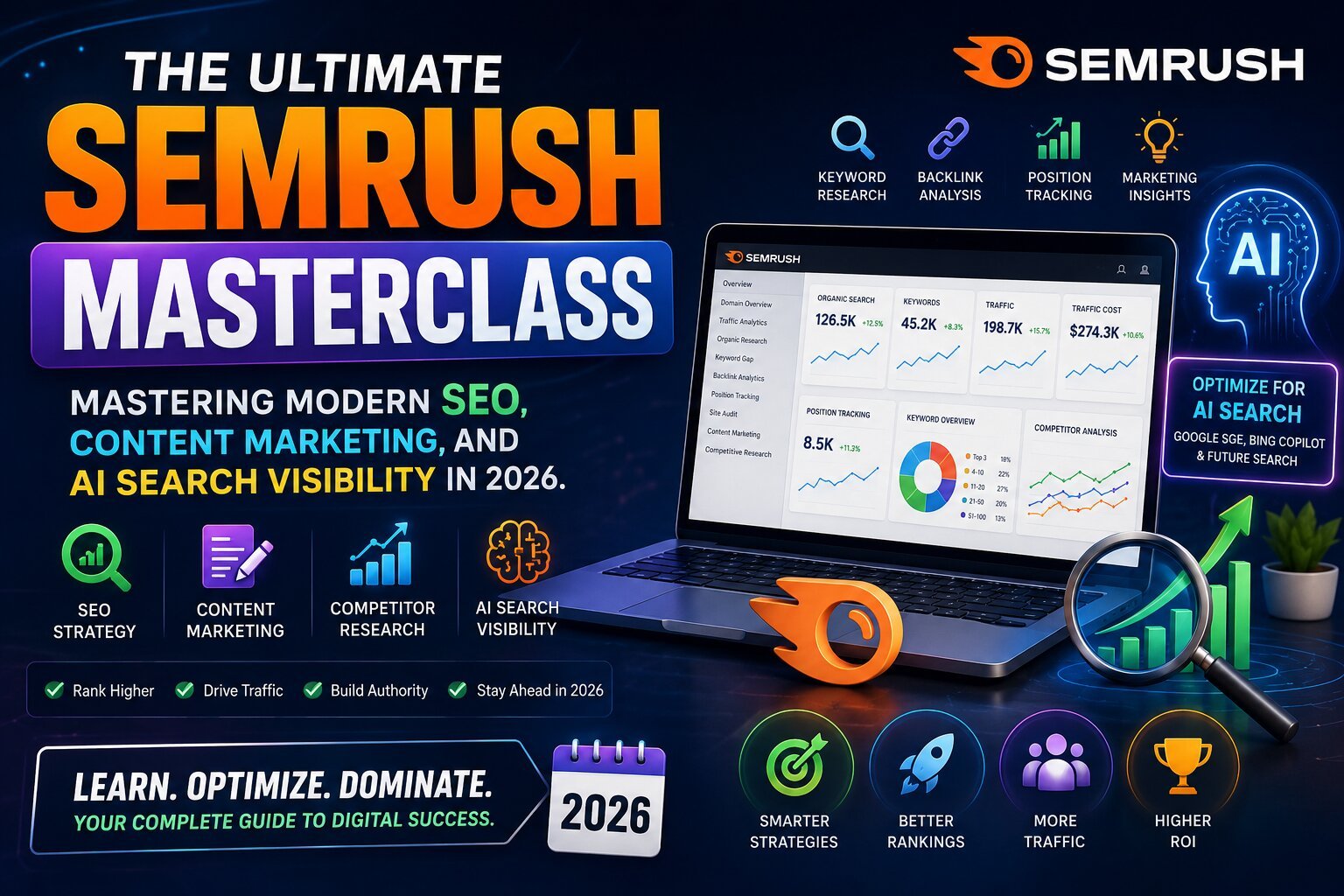
The Ultimate Semrush Masterclass: Mastering Modern SEO, Content Marketing, and AI Search Visibility in 2026
Remember when search engine optimization was straightforward? You would identify a high-volume keyword, weave it naturally into a 1,000-word blog post five or six times, build a handful of directory or guest-post backlinks, and watch your website climb the Google rankings. Weekly status reports were simple: check your position tracking dashboard on Monday morning, celebrate a three-spot jump, or stress over a sudden drop.
Fast forward to today, and the digital landscape looks entirely different. Traditional search engine results pages (SERPs) now share prime real estate with AI-generated overviews, conversational LLMs, rich snippets, and multi-platform digital discovery. Users no longer just search; they converse with AI, ask complex multi-intent questions, and expect instant, synthesized answers. If your digital marketing stack is still stuck in traditional SEO tactics from half a decade ago, you are effectively flying blind.
Enter the modern evolution of Semrush. Long celebrated as the undisputed heavyweight champion of keyword research and backlink analysis, Semrush has quietly transformed into a comprehensive digital visibility ecosystem. It is no longer just an “SEO tool”—it is a full-scale marketing intelligence command center designed to help businesses dominate organic search, paid advertising, social media, content marketing, and AI-driven discovery.
In this comprehensive guide, we will dive deep into why Semrush has become indispensable for modern marketers, break down its core capabilities, explore how to optimize for the new era of AI search, and provide a step-by-step masterclass on how to leverage the platform to outpace your competition.
1. The Paradigm Shift: From Blue Links to AI Search and Multi-Platform Discovery
The biggest game-changer in digital marketing isn’t just ranking on a traditional Google SERP anymore. The fundamental question every business must ask today is: How do AI engines perceive, process, and recommend your brand?
When users query modern search interfaces—whether through Google AI Overviews, ChatGPT, Gemini, Microsoft Copilot, or Perplexity—traditional keyword rankings tell only half the story. A brand can be mentioned and cited as an authoritative source in an AI-generated summary even if its specific domain isn’t occupying the traditional number-one organic blue link position. Conversely, a site ranking #1 might get bypassed entirely if an AI synthesis answers the user’s query right at the top of the page.
Adapting to AI Visibility
Semrush recognized this architectural shift early, evolving its toolsets to track modern search behavior. The platform integrates advanced tracking to help marketers understand:
- LLM and AI Overviews Integration: How often your brand or content appears inside AI-generated summaries across different queries.
- Content Citations: Which of your pages are being pulled as references by large language models, allowing you to reverse-engineer what makes content “AI-citation-worthy.”
- Hybrid Search Strategies: Bridging classic keyword intent analysis with prompt-based consumer habits so your content captures traffic from both human searchers and AI crawlers.
Understanding this shift is critical. Modern SEO is no longer just about beating an algorithm; it is about establishing genuine topical authority so thoroughly that both search engines and AI models recognize your brand as the definitive source of truth in your niche.
2. Core Pillars of the Semrush Toolkit
While AI search features capture headlines, Semrush’s foundational toolkits remain unmatched in scale, boasting a database spanning tens of billions of keywords and hundreds of millions of tracked domains across global markets. To master the platform, you must understand how its core pillars work together in a unified workflow.
A. The Domain & Competitor Overview Engine
Before writing a single line of code or drafting a single article, smart marketers spy on the competition. The Domain Overview tool acts as an open-book test for your industry. By plugging any competitor’s URL into Semrush, you instantly reveal:
- Organic Traffic Trends: Estimated monthly visitors and historical traffic fluctuations.
- Paid Search Footprint: Their active Google Ads campaigns, target ad keywords, and historical ad copy.
- Backlink Profile Growth: The velocity at which they acquire links and the exact domains pointing to them.
- Top-Performing Pages: Which specific URLs drive the lion’s share of their revenue and traffic.
This intelligence allows you to bypass months of trial and error. You can immediately identify content gaps—topics your competitors are ranking for that you haven’t covered yet—and build a targeted content calendar around proven demand.
B. The Keyword Magic Tool
Keyword research used to mean finding a high-volume phrase and hoping for the best. Today, relevance and intent matter infinitely more than raw volume. The Keyword Magic Tool provides access to over twenty billion keywords, filtering them by:
- Search Intent: Instantly separating Informational, Navigational, Commercial, and Transactional queries. This ensures you aren’t trying to sell a product on a page meant to educate, or vice versa.
- Keyword Difficulty (KD%): A color-coded metric estimating how hard it will be to rank in the top 10 based on the authority of currently ranking domains.
- SERP Features: Identifying whether a keyword triggers featured snippets, local packs, video carousels, or AI overviews, allowing you to format your content specifically to win those placements.
C. Technical SEO Auditing with Teeth
A website can have great content, but if its technical foundation is broken, search engines will struggle to crawl and index it. The Semrush Site Audit tool crawls your entire website, scanning for over 140 technical health issues.
Instead of spitting out an overwhelming developer log, Semrush categorizes errors into Errors, Warnings, and Notices, providing clear, plain-English explanations of why an issue matters and how to fix it. Common issues caught and resolved include:
- Broken internal and external links (404 errors).
- Slow page load speeds and Core Web Vitals bottlenecks.
- Missing or duplicate meta titles and descriptions.
- Hreflang implementation errors for international sites.
- Canonical tag misconfigurations causing duplicate content penalties.
3. Streamlining the Content Marketing Workflow
Creating high-ranking, engaging content used to require juggling five different browser tabs for research, outline generation, grammar checking, and SEO optimization. Semrush consolidated this fractured process into a cohesive Content Marketing Platform.
Step 1: Topic Research
Before committing to an article, use the Topic Research tool. Type in a broad subject, and Semrush aggregates subtopics, trending questions, and sub-queries based on what people are actively searching for and discussing across forums and blogs. This gives you instant headline ideas and angles that resonate with real user curiosity.
Step 2: The SEO Content Template
Once you select a target keyword, the SEO Content Template analyzes the top 10 organic rivals for that keyword on Google. It generates an instant brief containing:
- Semantically related words and secondary keywords you must include.
- Recommended text length based on top-performing competitors.
- Target readability scores.
- Suggested backlink targets.
Step 3: The SEO Writing Assistant (SWA)
Whether you write inside WordPress, Google Docs, or the native Semrush interface, the SEO Writing Assistant provides real-time optimization feedback as you type. It tracks four core pillars:
- Readability: Ensuring your sentences aren’t overly complex and your paragraphs flow naturally.
- SEO: Alerting you if you forgot key recommended terms or if your target keyword density is too high (keyword stuffing).
- Originality: Scanning the web to ensure your draft isn’t accidentally plagiarizing existing content.
- Tone of Voice: Checking whether your writing matches your brand’s desired tone (e.g., formal, casual, or neutral).
By merging writing assistance with live SEO scoring, you eliminate the guesswork, ensuring that every piece of content leaves your desk fully optimized to rank from day one.
4. Local SEO and Multi-Location Dominance
For businesses with physical storefronts—such as local service providers, retail shops, or regional enterprises—traditional global SEO is secondary to Local SEO. Ranking #1 nationally does you no good if your customer base is confined to a specific city or zip code.
Semrush handles local visibility through specialized tools designed to capture the coveted Google Local Pack (the map listings at the top of local searches):
- Listing Management: Automatically distributes and synchronizes your business name, address, and phone number (NAP) across major directories (Google Business Profile, Yelp, Facebook, TripAdvisor, etc.), ensuring data consistency that search algorithms reward.
- Position Tracking by Zip Code: Allows you to track your local rankings down to specific city blocks or postal codes, revealing exactly where you dominate and where competitors are outranking you locally.
- Review Management: Aggregates customer reviews from across the web into a single dashboard, allowing you to monitor sentiment, respond quickly, and maintain a stellar online reputation.
5. Paid Search (PPC) and Competitive Ad Intelligence
Organic search is a long-term investment that takes months to compound. When businesses need immediate traffic, leads, or sales, they turn to Paid Search (PPC) via Google Ads. However, running blind ad campaigns can quickly drain marketing budgets with zero return.
Semrush’s Advertising Research Toolkit lets you ethically spy on competitor ad strategies before you spend a single dollar of your own budget:
- Ad History and Variations: View the exact headlines, descriptions, and display URLs your competitors have used in their ads over the past several years.
- Estimated Ad Spend: Discover how much budget competitors allocate to specific keywords and campaigns.
- Ad Position Changes: Track how ad stability fluctuates for high-intent commercial keywords in your industry.
- PLA (Product Listing Ads) Research: For e-commerce brands, see which products competitors are featuring in Google Shopping ads and what imagery or pricing strategies they deploy.
By analyzing what is already working for established market players in the paid search arena, you can structure high-converting landing pages and ad copy right out of the gate while avoiding costly keyword traps.
6. Social Media Management and Analytics
Modern digital visibility extends far beyond search engines. Social media platforms function as secondary search engines, especially for younger demographics searching for travel recommendations, product reviews, and lifestyle advice.
Semrush includes robust social media tools to streamline multi-channel execution:
- Social Poster: Schedule, automate, and publish content across LinkedIn, Facebook, Instagram, X (formerly Twitter), Pinterest, and Google Business Profile from a single centralized dashboard.
- Social Tracker: Monitor your brand’s social performance side-by-side with your top competitors, tracking follower growth, engagement rates, posting frequency, and viral content across networks.
- Social Analytics: Measure the exact return on investment (ROI) of your social media campaigns by tracking click-through rates and website traffic generated directly from social posts.
7. Building a Sustainable Semrush Workflow: A Step-by-Step Blueprint
Knowing what tools exist is only half the battle; knowing how to integrate them into a daily, weekly, and monthly routine transforms raw data into real revenue growth. Here is a proven operational blueprint for mastering Semrush efficiency:
Weekly Routine: Health and Tracking
- Monday Morning Position Check: Review your Position Tracking campaigns. Look for sudden drops or spikes to identify algorithm updates or technical glitches immediately.
- Technical Health Scan: Check your Site Audit dashboard. Ensure new content or site updates haven’t introduced broken links, missing tags, or crawl errors.
- Social Review: Schedule your upcoming week’s social posts using the Social Poster and review engagement metrics from the previous week.
Monthly Routine: Strategy and Expansion
- Competitor Gap Analysis: Run a Keyword Gap and Backlink Gap analysis against your top three competitors to see what new ground they captured over the past 30 days.
- Content Performance Audit: Use Google Analytics integrated with Semrush to evaluate which blog posts and landing pages drove the most conversions, then update those pages with fresh data to maintain their rankings.
- PPC Review: Analyze your active paid campaigns alongside competitor ad movement to reallocate budget toward high-performing keywords.
8. Common Semrush Pitfalls to Avoid
Even seasoned marketers can fall into traps when using powerful enterprise software. Keep these guardrails in mind to maximize your ROI:
- Analysis Paralysis: It is easy to get lost in endless data loops, staring at graphs and metrics for hours without taking action. Always tie data back to a clear execution step (e.g., “This metric shows page X is losing traffic; therefore, we will update and expand its content this Thursday”).
- Chasing Vanity Metrics: Do not obsess over high search volume keywords that have zero commercial or informational relevance to your actual business goals. Prioritize search intent and conversion potential over raw traffic numbers every single time.
- Ignoring Local Nuance: If you operate regionally, do not optimize solely for national keyword volumes. Tailor your campaigns to local search intent to capture high-converting local buyers.
Conclusion: Securing Your Digital Future
The digital marketplace is more competitive, fast-paced, and algorithmically complex than ever before. Traditional marketing tactics—relying on guesswork, static spreadsheets, and isolated SEO tricks—no longer suffice in an era defined by AI search integration and multi-platform consumer discovery.
Semrush has evolved from a simple keyword checker into an all-encompassing growth platform because modern marketing requires a unified command center. Whether you are performing deep technical audits, reverse-engineering competitor ad spend, optimizing copy with real-time AI assistance, or tracking your brand’s presence across conversational search engines, Semrush provides the clarity, speed, and precision needed to win.
Search isn’t dying; it is expanding. By mastering the tools, workflows, and strategic frameworks outlined in this guide, you ensure that no matter where your next customer is searching—whether on a traditional Google results page or inside an AI-generated summary—they find your brand first.
ALSO YOU CAN READ:
1 thought on “The Ultimate Semrush Masterclass: Mastering Modern SEO, Content Marketing, and AI Search Visibility in 2026”